
Orange Park has neighborhoods built across more than five decades, and the older ones — sections of Lakeside, parts of original Orange Park proper, older Doctors Inlet, and the early Fleming Island developments — were wired to standards that no longer match how modern families use electricity. Knob-and-tube wiring in the oldest homes, aluminum branch wiring from the mid-1960s through mid-1970s, and undersized two-wire ungrounded systems from the 1950s and 1960s all show up in real estate transactions, insurance scrutiny, and inspection reports. A whole-home rewire is the right answer when patching the existing system is no longer worth the cost or the risk.
A whole home rewire is the complete replacement of a home’s branch wiring — every circuit, every outlet, every switch, every fixture connection — with modern copper romex (or appropriate alternatives) sized to current loads and installed to current National Electrical Code standards. It typically includes a panel upgrade or replacement, a complete grounding electrode system, full GFCI and AFCI protection on required circuits, and replacement of all outlets, switches, and fixture connections in the home.
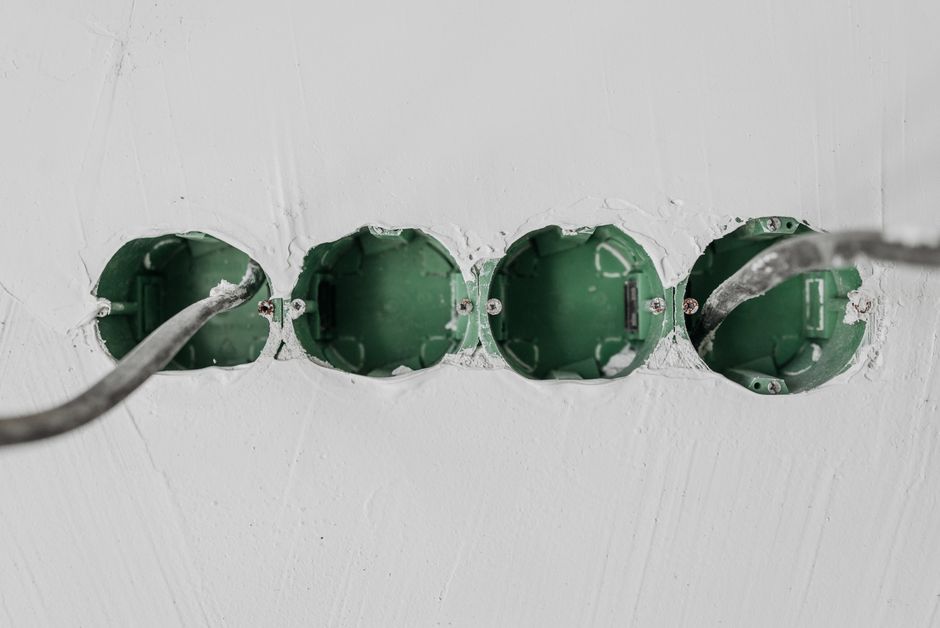
Three situations push a home from “needs upgrades” to “needs a full rewire.”
Homes built before about 1950 frequently still have some original knob-and-tube wiring — single insulated conductors run on ceramic knobs through framing, with ceramic tubes through joists. Knob-and-tube wiring has no equipment grounding conductor (no third prong), uses brittle insulation that becomes more brittle with age, and is increasingly difficult to insure in Florida. While knob-and-tube was safe by 1920s standards, it is not appropriate for modern homes, and partial replacement is generally not cost-effective compared to a complete rewire.
Aluminum branch wiring was used widely from about 1965 through the mid-1970s. The metal has a documented history of failures at connections — switches, outlets, fixture connections — because aluminum expands and contracts at different rates than the brass and copper materials it connects to. Loose connections heat up, arc, and start fires.
Two remediation approaches exist. The full rewire replaces all aluminum branch wiring with copper. The connector-based remediation uses listed connectors (COPALUM or AlumiConn) at every device to safely join aluminum to copper pigtails. Connector-based remediation is significantly cheaper but requires every device in the home to be retrofitted, including connections inside walls and ceiling boxes that may not be accessible. For homes that need significant other electrical work anyway, a full rewire is often the cleaner answer.
Homes built before about 1965 often have two-wire ungrounded branch circuits — hot and neutral, no separate equipment ground. Modern appliances, computers, and home electronics often expect a grounded circuit. The lack of grounding is also a real shock hazard for certain failure modes. While some remediation is possible with GFCI replacement of selected outlets, a full rewire is the only way to bring the entire system up to grounded modern code.
When a home is being substantially renovated — kitchen and bath remodels, additions, structural work that opens walls — adding a whole-home rewire to the project is often more efficient than incremental upgrades. Walls are already open. The labor of fishing new wire through closed walls is the most expensive part of rewiring, and a renovation removes that constraint.
What the homeowner actually sees during the work is usually less disruptive than they expect. The contractor pulls an electrical permit with the county — Duval, Clay, St. Johns, or Putnam depending on the address — before any work begins. If the main service is being upgraded, the utility is coordinated so the meter is pulled at the start of the day and reset before evening. The crew works through the planned scope in one to two days for most residential jobs, then the county inspector walks the work and signs off. The inspection card stays with the property and is the documentation a future buyer or insurance carrier will ask to see.
A whole home rewire is significant project. A real install for an ELR Electric customer in Orange Park starts with a comprehensive assessment — what wiring types are in the home, what the panel looks like, what loads need to be served, what the homeowner’s goals are. We produce a written scope of work and a real estimate.
We work with the homeowner on a circuit plan: how many circuits, where outlets and switches go, what the lighting layout looks like, what dedicated circuits the homeowner wants (home office, EV charger, workshop, kitchen appliances, HVAC). The plan goes to Clay County for permit, which is required for any whole-home rewire.
Most rewires start with a panel upgrade. A 200-amp service in a new panel becomes the foundation of the rest of the work. Grounding electrode system goes in or gets upgraded. Whole-house surge protection is installed at the new panel.
This is the bulk of the work. New copper romex circuits get run from the panel to every outlet, switch, and fixture location. Modern installations use AFCI breakers on most circuits and GFCI protection at required outlet locations. Old wiring is removed or abandoned as the new system takes over.
New outlets, switches, and fixture connections go in. We test every circuit, label the panel directory accurately, and walk through operation with the homeowner.
Clay County inspects the completed work. We coordinate any corrections, sign off the permit, and provide the homeowner with a complete documentation package — circuit plan, panel directory, photos, and warranty.
Older Jacksonville-area construction adds its own layer to this kind of project. Homes built in the 1970s and 1980s in neighborhoods like Mandarin, Arlington, Sandalwood, Lakeshore, and parts of Orange Park were wired to the standards of their era, which means fewer circuits, fewer outlets per room, and electrical layouts that assumed one television, one window air conditioner, and no home office. A modern household runs more devices on the same wiring, and the cumulative load shows up as warm outlets, dimming lights when the AC starts, and breakers that trip more often than they used to.
A whole home rewire is a real project. It takes time and money proportional to the size of the home, the difficulty of access, and the scope of the work. Honest pricing requires an in-home estimate; phone quotes from contractors who have not seen the home are guesses.
Timeline depends on the home. A vacant home being prepared for renovation rewires faster than an occupied home where the family is living through the project. We typically work room-by-room or zone-by-zone in occupied homes to maintain some functional electrical throughout the project. A typical Orange Park rewire runs one to three weeks of active work; full timeline including permitting and inspection is longer.
The National Electrical Code drives most of the safety requirements that apply to this work. NEC Article 210.8 mandates GFCI protection in kitchens, baths, garages, laundries, outdoor receptacles, and anywhere within six feet of a sink — the goal is to shut the circuit off in milliseconds when current finds a path through a person instead of through the intended wires. NEC Article 210.12 mandates arc-fault protection on most residential branch circuits, which catches the kind of low-energy arcing inside damaged insulation that starts hidden wall fires. Bringing a home into compliance with these articles is one of the most direct safety improvements an upgrade delivers.
A whole-home rewire triggers most of the residential NEC requirements.
NEC Article 210.8 — GFCI protection on kitchen, bath, garage, basement, laundry, outdoor, and near-sink outlets.
NEC Article 210.12 — AFCI protection on most residential branch circuits.
NEC Article 210.11 — required dedicated branch circuits for small appliances, laundry, bathroom, and other specific loads.
NEC Article 250 — complete grounding electrode system and bonding.
NEC Article 230.67 — surge protective devices on new dwelling services.
NEC Article 408 — accurate panel directory and labeling.
All of these get implemented during a real whole-home rewire. The end state is a code-compliant modern system, not a patched older one.
Whole home rewiring is permit-required electrical work performed by a licensed electrical contractor registered with the DBPR ECLB. Permits go through the Clay County building department for Orange Park projects. The licensing requirement protects the homeowner — work performed by unlicensed individuals can void homeowners insurance, create resale problems, and produce code violations the next inspection catches.
A few situations call for something other than a full rewire.
If the existing wiring is modern copper romex with proper grounding, AFCI/GFCI protection can be added at the panel without a rewire.
If only a portion of the home has problematic wiring — for example, only the kitchen has aluminum, or only the garage circuits are ungrounded — a partial rewire of the affected zones is more cost-effective than touching the whole house.
If the goal is only a service upgrade, a panel replacement without rewiring the branch circuits is the right scope.
A real electrician will tell you which scope fits your situation during the estimate visit. Recommending a full rewire when a smaller scope works is not the honest answer.
ELR Electric is a licensed Florida electrical contractor serving Orange Park, Fleming Island, Middleburg, and the broader Clay County area. We provide thorough rewire estimates, phase work to fit the homeowner’s reality, pull Clay County permits, and complete the project to current NEC standards. Call us to schedule an in-home estimate.
Learn more about our work in your area on our Orange Park electrician page and our Middleburg electrician page.