
The kitchen is the hardest-working room in any NE Florida home. Between long humid summers that keep families indoors, hurricane-season prep that turns the kitchen into a command center, and older Jacksonville and Orange Park homes still running a single overhead fixture from the 1970s, the gap between what most kitchens have and what they actually need is enormous. A planned lighting upgrade fixes that gap, and it does it for less than almost any other kitchen project.
A kitchen lighting upgrade is a planned redesign of the room’s electrical lighting layout, usually combining three layers — ambient, task, and accent — using modern LED fixtures, dimmer controls, and updated wiring. The work covers fixture replacement, new switch locations, recessed cans, under-cabinet strips, and pendant lighting over islands or dining counters, all installed to current National Electrical Code requirements.
Florida kitchens deal with environmental stress most parts of the country never see. Humidity sits above 70 percent for months at a time, which corrodes older fixtures and shortens bulb life. Hurricane season, June through November, often means cooking by lantern or generator power — and a kitchen wired with one ceiling fixture loses everything when that fixture goes out. Coastal homes in Ponte Vedra, St. Augustine, and Nocatee also fight salt air, which attacks any fixture not rated for damp or wet locations.
Older homes in Orange Park, Mandarin, Middleburg, and Riverside-area Jacksonville were often built before kitchen island cooking and home-office breakfast bars became standard. The original electrical plan assumed one cook, one overhead light, and a wall switch by the door. That plan does not work for modern kitchens, and it does not match how Florida families actually use the room.
What the homeowner actually sees during the work is usually less disruptive than they expect. The contractor pulls an electrical permit with the county — Duval, Clay, St. Johns, or Putnam depending on the address — before any work begins. If the main service is being upgraded, the utility is coordinated so the meter is pulled at the start of the day and reset before evening. The crew works through the planned scope in one to two days for most residential jobs, then the county inspector walks the work and signs off. The inspection card stays with the property and is the documentation a future buyer or insurance carrier will ask to see.
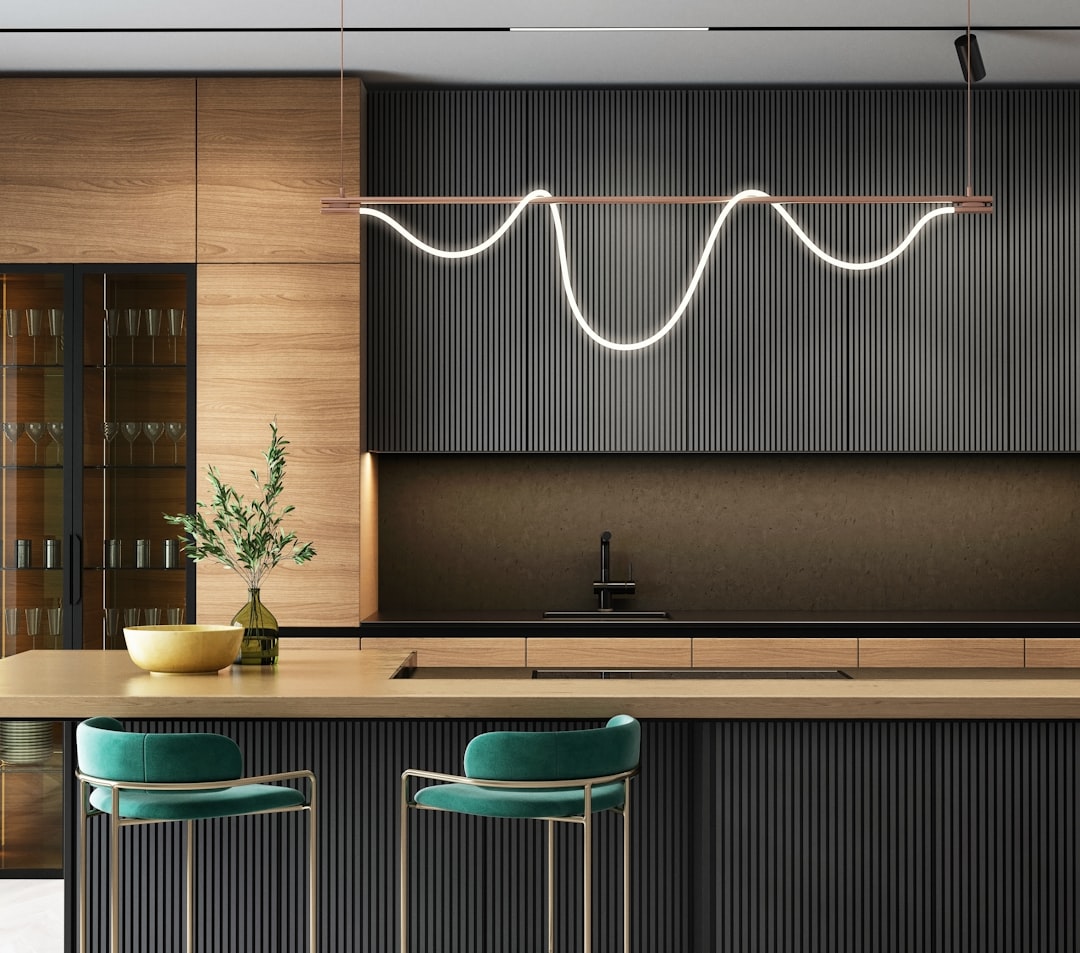
Professional kitchen lighting design uses three coordinated layers. Skipping a layer leaves dark spots, eye strain, and rooms that feel smaller than they are.
Ambient lighting is the base layer — the general illumination that lets you safely walk through the room. Recessed LED cans on a dimmer circuit are the standard choice today, usually four to eight cans arranged on a grid above the main floor area. A flush-mount or semi-flush center fixture can supplement this in smaller kitchens.
Task lighting puts light exactly where you cut, chop, read recipes, and clean. Under-cabinet LED strips are the most common task layer, mounted to the front edge of upper cabinets so the light falls on the counter, not in your eyes. Pendant lights over an island or peninsula also serve as task lighting for prep and casual dining. Without a task layer, your own body blocks the ceiling lights and you end up cutting in your own shadow.
Accent lighting is the layer most homeowners skip and most professional designers insist on. It includes toe-kick LED strips under base cabinets, in-cabinet lighting for glass-front uppers, and small directional fixtures over open shelving or a backsplash feature. Accent lighting is what makes a kitchen feel finished rather than just lit.
Florida has the highest density of cloud-to-ground lightning strikes of any state in the United States, and thunderstorm-heavy summer afternoons from June through September push every home electrical system harder than the rest of the year. A direct strike is rare; a nearby strike that sends a damaging surge into the home wiring through the utility lines, the cable feed, or the phone line is common. NE Florida homeowners who have lived here through a few storm seasons usually have a story about a fried garage-door opener, a dead refrigerator board, or a router that stopped working after a loud night.
LED bulbs and fixtures use roughly 75 percent less energy than incandescent and last 15 to 25 times longer, according to the U.S. Department of Energy. In a humid Florida kitchen where you may run the lights eight to twelve hours a day during summer, that gap matters on the power bill and on how often you change bulbs.
LEDs also produce far less heat than incandescent or halogen, which keeps your kitchen cooler — a real benefit when outdoor temperatures sit in the mid-90s for weeks at a stretch. Choose fixtures in the 2700K to 3000K range for warm white light that flatters food and skin tones, or 3500K to 4000K for a brighter, more modern look. Anything above 5000K tends to feel clinical in a residential kitchen.
A note on the U.S. Environmental Protection Agency’s ENERGY STAR program: the agency sunset the ENERGY STAR specification for lamps and luminaires at the end of 2024. Look for FTC Lighting Facts labels and reputable manufacturer warranties instead of relying on the old ENERGY STAR mark for bulbs.
The National Electrical Code drives most of the safety requirements that apply to this work. NEC Article 210.8 mandates GFCI protection in kitchens, baths, garages, laundries, outdoor receptacles, and anywhere within six feet of a sink — the goal is to shut the circuit off in milliseconds when current finds a path through a person instead of through the intended wires. NEC Article 210.12 mandates arc-fault protection on most residential branch circuits, which catches the kind of low-energy arcing inside damaged insulation that starts hidden wall fires. Bringing a home into compliance with these articles is one of the most direct safety improvements an upgrade delivers.
Kitchen lighting work is governed by the National Electrical Code, which Florida adopts as part of the Florida Building Code. Two NEC articles drive most of the safety requirements in a kitchen project.
NEC Article 210.8 requires GFCI protection for receptacles serving kitchen countertops and for receptacles within six feet of a sink. While this rule covers outlets more than lighting, any lighting upgrade that touches a switch box or junction near a counter outlet typically requires bringing the affected circuits up to current GFCI standards.
NEC Article 210.12 requires AFCI (arc-fault circuit interrupter) protection on most residential branch circuits, including those serving kitchen lighting in many configurations. When a licensed electrician opens up wiring during an upgrade, AFCI compliance is part of the inspection.
In Florida, electrical work that requires a permit must be performed by a licensed electrical contractor regulated by the Florida Department of Business and Professional Regulation’s Electrical Contractors’ Licensing Board (DBPR ECLB). Permits are pulled through your county building department — Duval, St. Johns, or Clay for most of our service area. Homeowner-permit DIY is restricted and usually a bad idea once you go beyond replacing a like-for-like fixture.
A typical project for an ELR Electric customer in Orange Park, Middleburg, or Jacksonville starts with a walkthrough. We map the existing circuits, look at where you actually stand and work, and ask what bothers you about the current lighting. Most homeowners want brighter counters, fewer shadows, and dimmers — almost no one asks for more wattage, they ask for better-placed light.
The install itself usually runs one to two days for a standard layout. Recessed cans go in first, then under-cabinet wiring is fished through the wall above the counter, then pendants and switches. Drywall patching is minimal when an experienced electrician plans the runs through cabinet voids and existing chases. Old fixtures, switches, and any non-compliant wiring come out and get replaced.
Permit and inspection close the job. Your county building department signs off, and you get a system that meets current code, qualifies for any homeowner-insurance credit your carrier offers for updated electrical, and adds documented value if you sell.
Homeowners doing their own lighting plan, or hiring a handyman without an electrical license, run into the same problems repeatedly. The biggest is undercounting recessed cans — a kitchen needs roughly one four-inch LED can per twenty to twenty-five square feet of floor space for proper ambient coverage. Smaller numbers leave dark spots no amount of dimmer adjustment fixes.
The second is choosing color temperature on a screen instead of in person. A 5000K LED looks fine on a Home Depot product page and feels harsh and blue once it is over your dining table. Always check sample bulbs in the actual room before buying twenty of them.
The third is forgetting dimmers. Every layer in the lighting plan should be on a dimmer — ambient, task, and accent — and each layer should be on its own switch. A single dimmer that controls every light in the kitchen gives you one mood, not a flexible system.
ELR Electric is a licensed Florida electrical contractor serving Orange Park, Middleburg, Jacksonville, and the surrounding NE Florida communities. We design layered lighting plans, pull permits, install to current NEC standards, and stand behind the work. Call us to schedule an in-home estimate and we will walk through your kitchen, listen to how you actually use it, and put together a plan that fits your home and your budget.
Learn more about our work in your area on our Orange Park electrician page or our Jacksonville electrician page.