
Northeast Florida is one of the most lightning-prone regions in the United States. Jacksonville, Orange Park, Ponte Vedra, and the rest of the I-95 corridor see dozens of significant thunderstorms every summer, and every one of them sends voltage spikes down power lines, into meters, and through the wiring in your home. A power strip in the family room is not protection against that — a whole-house surge protector at the main panel is. Here is how the system actually works, what it costs to install, and why it matters more in NE Florida than almost anywhere else in the country.
Whole-house surge protection is a hardwired device installed at your electrical service panel that diverts excess voltage to ground before it reaches the branch circuits in your home. It guards every outlet, fixture, and appliance simultaneously, rather than protecting only the things plugged into a single power strip. Modern units use metal-oxide varistors (MOVs) and gas discharge tubes to absorb spikes in nanoseconds, and rated joule capacity determines how much surge energy the device can handle before it sacrifices itself to save your electronics.
The National Lightning Detection Network has recorded Florida as the most lightning-prone state in the country for decades, and the I-95 corridor between Jacksonville and St. Augustine sits in the heart of the activity. A single nearby strike does not have to hit your house to damage equipment inside it. Strikes induce voltage spikes on power lines, telephone lines, cable lines, and even on the ground itself, and those spikes travel into your home through any conductor connected to the outside world.
Beyond lightning, two other surge sources matter. Utility-side switching — when JEA, Clay Electric, or your local utility opens and closes feeders during storms or maintenance — creates spikes that travel directly down service lines. Internal surges from large motor loads inside your own home, like air conditioners, pool pumps, and refrigerator compressors, account for a surprising share of cumulative electronics damage over time.
The result is that NE Florida homes typically run with a higher background rate of small surges, plus occasional very large lightning-related events, that no plug-in strip is rated to handle alone.
What the homeowner actually sees during the work is usually less disruptive than they expect. The contractor pulls an electrical permit with the county — Duval, Clay, St. Johns, or Putnam depending on the address — before any work begins. If the main service is being upgraded, the utility is coordinated so the meter is pulled at the start of the day and reset before evening. The crew works through the planned scope in one to two days for most residential jobs, then the county inspector walks the work and signs off. The inspection card stays with the property and is the documentation a future buyer or insurance carrier will ask to see.
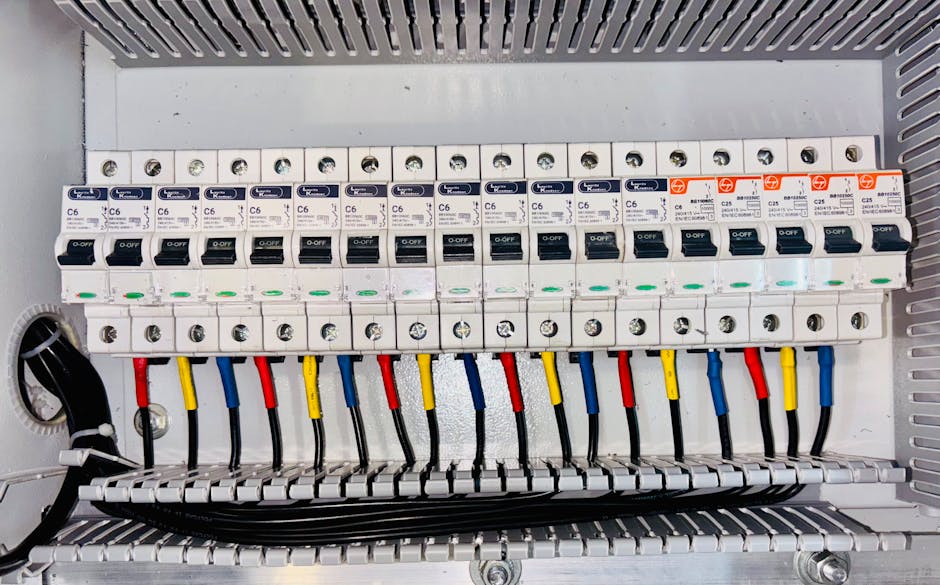
A Type 1 or Type 2 whole-house surge protector installs at or just downstream of the service entrance — usually in the main panel — and connects between the hot bus bars and ground. Under normal conditions, the device is invisible to the circuit; voltage stays within its design range and no current flows through the protector. When a surge arrives, the MOVs inside the protector switch from non-conducting to conducting in nanoseconds, dumping the excess voltage to ground until the spike passes. Then the device returns to standby.
The joule rating describes how much surge energy the device can absorb before its MOVs degrade. Higher joule ratings cost more and last longer in heavy-storm regions. A good whole-house protector for a NE Florida home is typically rated at 40,000 amps short-circuit current and a joule capacity sized for the local lightning frequency.
This first line of defense pairs well with a second, smaller layer at sensitive equipment — surge-protected outlets or strips at the TV, computer, and home office, which catch what the panel-level device lets through. Together they form a layered defense, and the panel-level device handles the heavy lifting.
Florida has the highest density of cloud-to-ground lightning strikes of any state in the United States, and thunderstorm-heavy summer afternoons from June through September push every home electrical system harder than the rest of the year. A direct strike is rare; a nearby strike that sends a damaging surge into the home wiring through the utility lines, the cable feed, or the phone line is common. NE Florida homeowners who have lived here through a few storm seasons usually have a story about a fried garage-door opener, a dead refrigerator board, or a router that stopped working after a loud night.
A few myths are worth clearing up. Whole-house surge protection does not stop a direct lightning strike to your home — that is a different problem requiring a roof-level lightning protection system. It does not prevent power outages or brownouts. It does not protect against long-duration overvoltage events from utility-side problems lasting more than a few milliseconds. And it does not last forever; the MOVs inside degrade with each surge they absorb, and most quality devices have an indicator light or LED that signals when the unit needs replacement.
The device is also not a substitute for code-required GFCI and AFCI protection on individual circuits. Those handle ground faults and arc faults inside the home; the surge protector handles voltage spikes coming from outside it.
The National Electrical Code drives most of the safety requirements that apply to this work. NEC Article 210.8 mandates GFCI protection in kitchens, baths, garages, laundries, outdoor receptacles, and anywhere within six feet of a sink — the goal is to shut the circuit off in milliseconds when current finds a path through a person instead of through the intended wires. NEC Article 210.12 mandates arc-fault protection on most residential branch circuits, which catches the kind of low-energy arcing inside damaged insulation that starts hidden wall fires. Bringing a home into compliance with these articles is one of the most direct safety improvements an upgrade delivers.
A whole-house surge protector install is a relatively simple project for a licensed electrician — the device itself is small, mounts inside or next to your main panel, and connects to a dedicated double-pole breaker. Total time on site is usually one to two hours, including pulling the meter or shutting down the main breaker, mounting the device, landing the conductors, restoring power, and verifying operation.
A typical install includes the surge protector itself, the dedicated breaker, the supply conductors, any required panel modifications, the Clay County, Duval County, or St. Johns County permit, and the inspection. The right device for a NE Florida home depends on your service size (200-amp is the most common), the available space in your panel, and your protection priorities — homes with extensive smart-home equipment, home theater, or solar PV often benefit from a higher-joule device.
For older homes with full panels, the electrician may need to relocate breakers, add a sub-panel, or use a load-side install with a small adjacent enclosure. None of that is unusual, but it does affect the time and cost of the job.
Honest pricing depends on the device, the panel, and the complexity of the install — so an in-home estimate beats a guess from a blog post. That said, the rough range for whole-house surge protection in NE Florida includes the device, the breaker, the labor, and the permit fee. Higher-joule devices, devices with built-in monitoring, and panels that need rework cost more. Adding point-of-use surge strips at TVs and computers is a small additional cost and is worth doing.
The value calculation is straightforward. The cost of replacing a refrigerator, an HVAC control board, a home theater system, a home office computer, and a smart panel after a single lightning event easily exceeds the cost of a panel-level surge protector by an order of magnitude. Insurance may cover some of that damage, but with a deductible, time without your appliances, and the headache of claim paperwork. A whole-house protector is one of the highest-leverage electrical upgrades in NE Florida.
NEC Article 230.67 requires surge protective devices on services supplying dwelling units in newly constructed homes. For existing homes, surge protection is not retrofit-mandatory, but it is the single most-recommended electrical upgrade for high-lightning regions.
Installation is permit-required work in Florida and must be performed by a licensed electrical contractor regulated by the DBPR ECLB. Permits are pulled through your local building department — Duval for Jacksonville, Clay for Orange Park and Fleming Island, St. Johns for Ponte Vedra and St. Augustine.
A surge protector mounts to your existing main panel. If the panel itself is old, undersized, or unsafe — a Federal Pacific Electric (FPE) Stab-Lok panel, a Zinsco panel, or a 60- or 100-amp service in a home that has long since outgrown it — replacing the panel comes first, and the surge protector goes in as part of the new install. Mounting modern surge protection on a panel that itself is a known fire risk is solving the wrong problem.
A real electrician will tell you that during the estimate visit. If you have an FPE or Zinsco panel, replace the panel. The surge protector belongs on a healthy panel.
ELR Electric is a licensed Florida electrical contractor serving Jacksonville, Orange Park, Fleming Island, Ponte Vedra, St. Augustine, and the surrounding communities. We install whole-house surge protection at the main panel, pair it with point-of-use protection for sensitive equipment, and pull the permits required by your county. Call us to schedule an in-home estimate.
Learn more about our work in your area on our Jacksonville electrician page and our St. Augustine electrician page.